

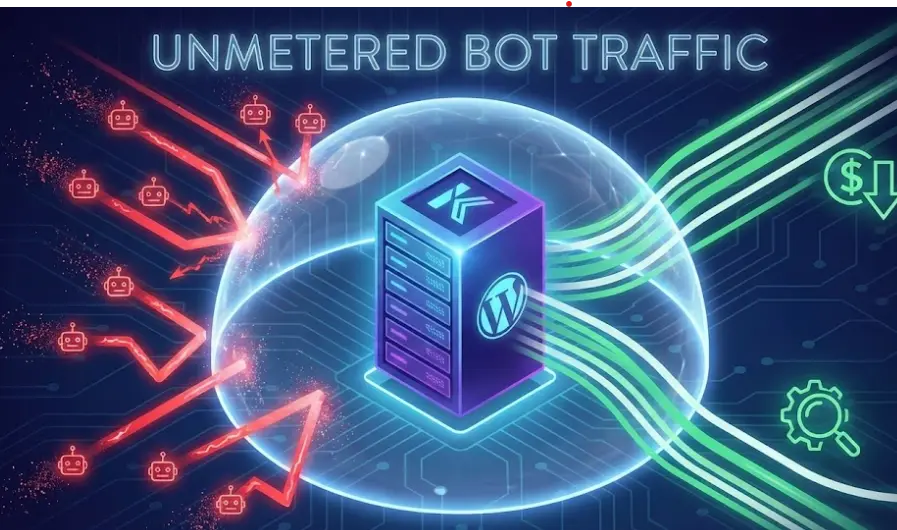

Executive Summary: In a significant move for the managed WordPress hosting landscape, Kinsta has announced a billing model update that eliminates charges for bandwidth consumed by unwanted bots and scrapers. This strategic pivot addresses the exponential rise in AI-driven crawler activity, ensuring clients no longer pay for non-human traffic overhead that does not contribute to business growth.
The intersection of infrastructure costs and technical SEO is becoming increasingly critical. As Large Language Models (LLMs) and AI agents aggressively crawl the web to train their datasets, server resource consumption has spiked globally. For high-traffic WordPress sites, this often translates to inflated bandwidth bills caused purely by external scraping tools. Kinsta’s recent policy change highlights a necessary evolution in how hosting providers account for this “phantom” traffic.
The Technical Reality of AI Bot Traffic
The proliferation of AI bots has fundamentally altered server load dynamics. According to recent Industry Reports, bot traffic is no longer a marginal anomaly but a dominant consumer of resources. This shift forces technical strategists to reconsider how hosting budgets are allocated.
Here is the breakdown of the technical impact:
- AI Scraper Resource Consumption: The surge in AI-powered bots significantly impacts bandwidth consumption, often mimicking legitimate user behavior while aggressively harvesting data.
- Disproportionate Cost Burden: For many enterprise-level sites, bot traffic can account for up to 50% of total bandwidth costs, a financial drain that offers zero conversion value.
- Billing Model Evolution: Kinsta’s decision to exclude scraper traffic from billing limits acknowledges that site owners should not be penalized for the global race to scrape data.
Impact on WordPress Infrastructure Strategy
For Technical SEOs and IT Directors, this development signals a need to audit current hosting environments. While a hosting provider may filter bad traffic, the financial responsibility for that traffic has historically fallen on the client. Removing this cost barrier allows budget reallocation toward performance optimization rather than resource defense.
At WP SEO Atlas, our comprehensive technical SEO services focus heavily on optimizing this infrastructure-to-value ratio. We ensure that your hosting environment supports your rankings without bleeding budget due to external factors like aggressive scraping.
Action Plan for Technical SEO Managers
To capitalize on this industry shift and protect your digital assets, we recommend the following strategic actions:
- Review Existing Hosting Agreements: Immediately audit the policies of your current provider regarding bandwidth billing. Determine if you are subsidizing AI training data through your monthly invoices.
- Deep-Dive Log Analysis: Analyze your server access logs to quantify the exact volume of bot traffic vs. human traffic. This data is crucial for negotiating contracts or planning migrations.
- Fortify Edge Defenses: Consider implementing or strengthening Web Application Firewalls (WAF) or CDN solutions to mitigate unwanted traffic at the edge before it hits your origin server, regardless of your host’s billing policy.
Read Also: How Brand Mentions in AI Search Are Changing SEO
Conclusion
The move to unmetered bot traffic in managed WordPress hosting is a welcome correction in the market. As AI agents continue to saturate the web, the distinction between “traffic” and “value” must be reflected in infrastructure costs. Technical SEOs must remain vigilant, ensuring their hosting partners are adapting to this new reality.
Recommended Resource: Search Engine Journal RSS Feed